Agentic engineering recommendations
Opinionated recommendations for people who want to follow our AI guiding principles as part LLM-assisted software engineering.
Provider recommendations
Here are the options we recommend from our comparison of inference providers:
- TensorX. EU company working with US (Ireland) and EU (Finland) data center providers. Wide range of models, good prices, very basic management features.
- Neuralwatt. US company with a unique energy transparency and pricing model. Most competitive prices.
- Scaleway. EU company with data centers in Europe. Small range of models, high prices, good management features.
The focus is on capabilities, transparency, clear model lifecycle, sovereignty.
SWE harness recommendations
We recommend using a harness that has good support for multiple inference providers. This will allow you to easily switch between the models/offerings of different companies to test various capabilities.
CLI options
- OpenCode. Automatically configures itself for a wide range of providers via the models.dev database.
- pi. Has a limited set of supported providers. Requires manual custom models configuration for the ones not on this list.
- Open Code Review. For code review only.
View our agentic engineering setup docs for configuration examples and more tool-specific guidance.
IDE options
- VS Code. Requires manual models configuration.
Other options
There are a lot of other options out there. Here are our criteria for inclusion on this list:
- Open source software that is free to install and use.
- Supports multiple providers, including unknown/custom endpoints, with easy switch between them.
Let us know if you have other suggestions, on the Wagtail Slack.
SWE model recommendations
Expect to change models every 2-3 months. See comparing open weight AI models for the rationale.
Current recommendations:
- GLM 5.3 Flash for 95% of tasks (capable, cheap, fast). Make sure your harness can set thinking/reasoning to "high" or "max" effort for the best results.
- GLM 5.3 for the top 5% of more demanding tasks.
Supporting tools and techniques
Cost control options
We recommend focusing on 100% usage-based billing, with cost control achieved with spend quotas rather than subscriptions. If SWE usage starts to exceed the quotas, it should be an encouragement to reign in cost by using smaller models or prompting more carefully (smaller context windows, more caching).
Start by setting a budget. For personal AI use, we recommend $10/month per developer. For professional use, we recommend $100/month. With the right model choice, those budgets are plenty enough for agent-heavy coding sessions.
For coding tasks with a heavy ratio of cached input tokens compared to output, here are expected equivalences:
Here are expected prices / token budgets based on the cost per task of models:
- $1/1M tokens: flagship models for top 5% planning / high complexity tasks.
- $0.10/1M: medium model for most tasks.
- $0.01/1M: price-sensitive occasional tasks.
Monitor your usage and its cost
Make sure your harness is set up to report on tokens usage, cache hit rates, and costs, with the correct cost rates per your provider.
Use AgentsView to track your personal usage across projects / providers / models. Here’s an example, showing which models were used over the last 30 days:
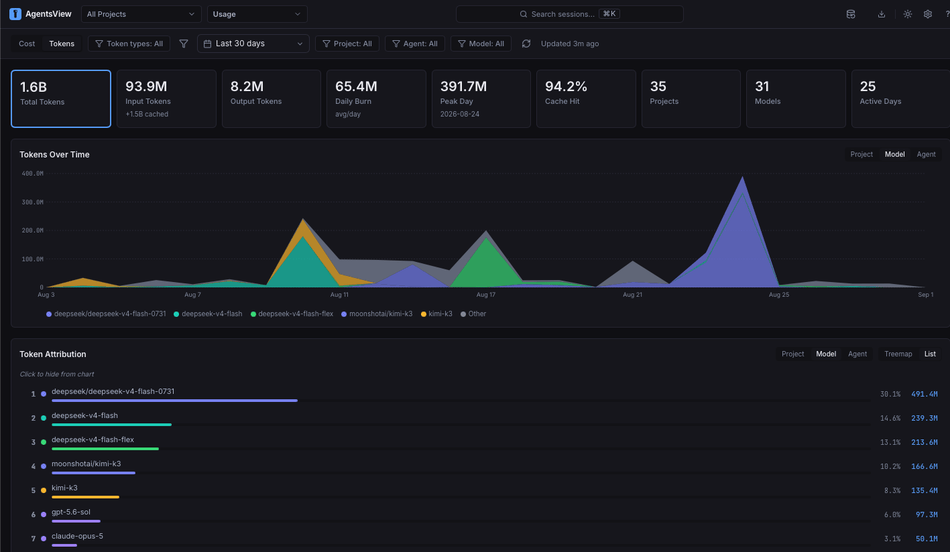
Note: AgentsView reports correct token counts for a wide range of agents. Costs are indicative only, they are based on manually-updated LiteLLM data that will always be out of sync with inference providers.
More efficient prompting
To reduce AI costs and environmental impacts, aside from considered model selection, we recommend adopting the following techniques:
- Subagents
- Spec-driven development / "plan mode", like superpowers.
- Agent-optimized tools (relying on CLIs or MCP servers rather than bash scripts)
Agentic SWE efficiency tips
- Write scripts with code for tasks that could be deterministic and AI-free.
- Use smaller models.
- Switch to more recent and efficient models.
- Provide automated verification for AI agents so they complete tasks more reliably.
- Use more advanced prompting techniques to get better results out of smaller models.