Wagtail accessibility statistics for GAAD 2026
Five years of Wagtail accessibility data. 2026 is the first year everything improved

Just like for Global Accessibility Awareness Day in 2024 and 2025, we're back with statistics on the accessibility of sites built with Wagtail. This year is a first: every indicator we track has moved in the right direction! 🎉 That's worth pausing on. But it doesn't change the bigger picture, which is that most website homepages still have many accessibility issues, and detectable issues are only the surface.
Key results
- All-time high for issue-free homepages: 6.16% had no detected issues, up from 5.06% last year. The biggest year-on-year jump in five years of tracking.
- Every built-in check improved: button-name, frame-title, heading-order, image-alt, and link-name all gained ground over 2025.
- "File names in alt text" have more than halved: from 29.9% of CMS-managed images down to 13.7% in two years. Strong signal our ongoing alt text improvements are paying off!
- Government Wagtail sites lead the pack: the UK scores a perfect 100 and France 99, both anchored by accessible national design systems.
The trend lines seem pretty clear, and the tools we've built are visible in the data. That's great news. The honest news is that 6.16% means 93.8% of Wagtail homepages still have at least one detectable issue. This is clearly above industry averages but nowhere near our ambitions.
Wagtail sites with no accessibility issues
We need to aim higher with all things accessibility. We can’t catch all issues with automated tools, but getting no issues detected from them is certainly a good place to be. Issue-free homepages are at their highest share yet, and the year-over-year jump looks clearly bigger than possible dataset noise.
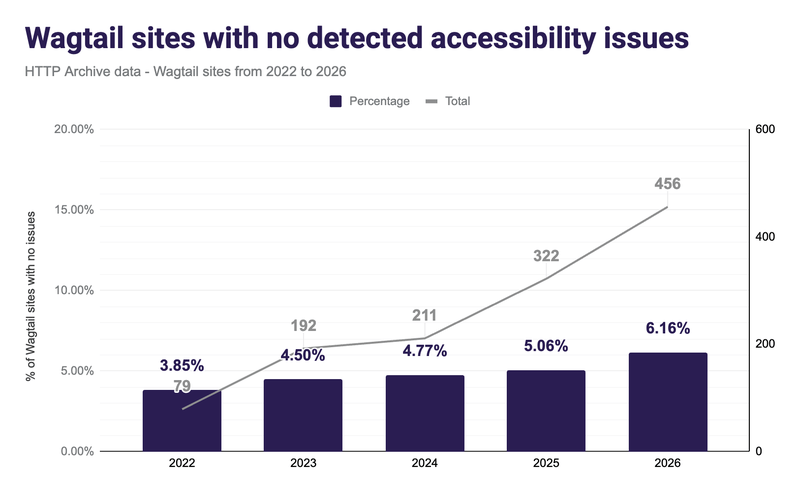
In 2026, we found 6.16% had no detected issues, compared to 5.06% in 2025, 4.77% in 2024, 4.44% in 2023 and 3.83% in 2022. We hope our commitment to the ATAG 2.0 standard will help all Wagtail sites get there, with tools like our content checker paving the way.
Government websites
Following the lead of the 2025 Web Almanac, we thought it would be interesting to look into the accessibility scores of government websites built with Wagtail. Every country in our top 10 of govt sites improved on its 2025 score. A result we didn't expect to see so cleanly across the board. Government sites get a lot of scrutiny when it comes to accessibility, so it's worth pausing on the fact that the public-sector slice of the Wagtail ecosystem is collectively moving in the right direction.
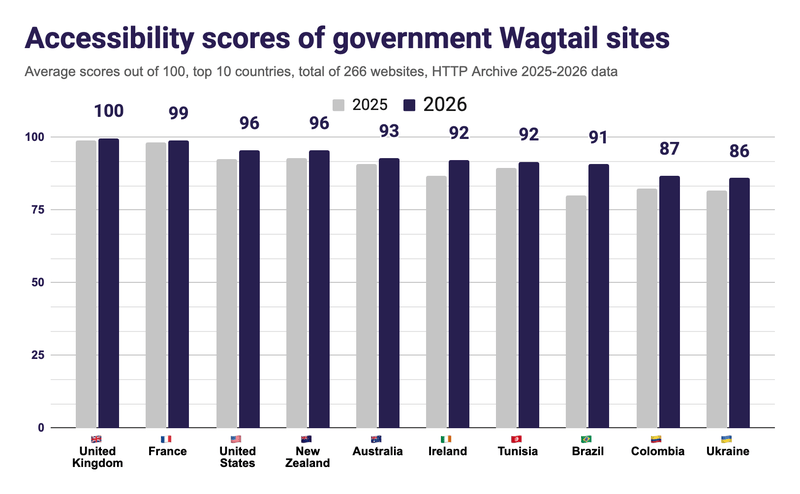
Of 266 websites present in this shortlist, the United Kingdom takes the lead as the only country with a perfect "100", with France a point behind at 99. Those two scores are likely much higher than other governments' because of how accessible the design systems of France and of the UK are. In particular, the French government has invested in Sites Conformes, an official Wagtail integration of their design system.
The standout mover is Brazil, climbing 11 points (80 → 91), by some margin the biggest year-on-year jump in the top 10. Ireland (+5), Tunisia (+3), New Zealand (+3), and the United States (+4) all made meaningful gains too. None of the top 10 lost ground 🎉.
Here are all the countries in our top 10:
- 🇬🇧 United Kingdom: 100 (up from 99)
- 🇫🇷 France: 99 (up from 98)
- 🇺🇸 United States: 96 (up from 92)
- 🇳🇿 New Zealand: 96 (up from 93)
- 🇦🇺 Australia: 93 (up from 91)
- 🇮🇪 Ireland: 92 (up from 87)
- 🇹🇳 Tunisia: 92 (up from 89)
- 🇧🇷 Brazil: 91 (up from 80)
- 🇨🇴 Colombia: 87 (up from 83)
- 🇺🇦 Ukraine: 86 (up from 82)
Success rate of Wagtail built-in checks
All five checks we track improved this year. The first time that's happened. This is clear signal that the built-in checker is doing real work in real sites!
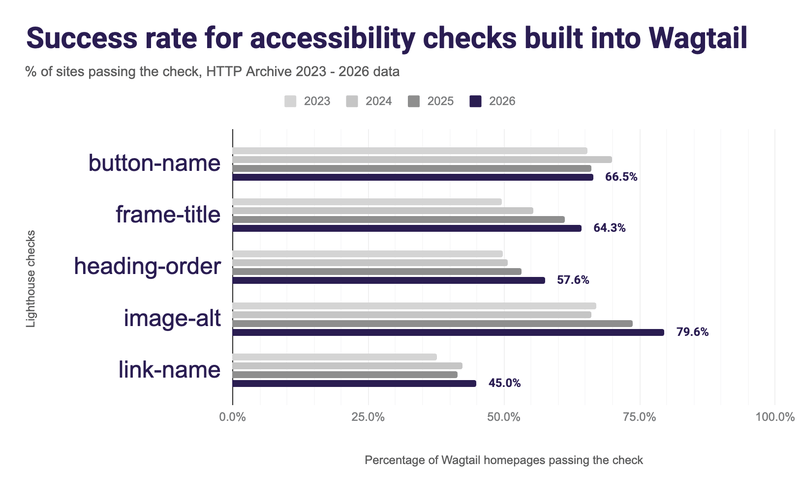
- button-name: 66.5% of Wagtail sites pass this, up from 65% in 2025. A button element on the page is lacking a label. This is entirely detectable with automated tests such as those featured in our built-in accessibility checker, built on Axe.
- frame-title: 64.3% of sites passing, increasing from 61% in 2025. A frame (such as an embedded video) is missing its title. Again entirely detectable with automated tests – and very simple to fix once identified!
- heading-order: 57.6% passing, increasing slightly from 53% in 2025. Some heading levels are getting skipped on the page – always have a main heading (h1) followed by subheadings (h2, h3, etc.).
- image-alt: we introduced this check in 2025, and now 79.6% of site homepages pass this, sharply increasing over time. There is a lot of improvements to be made to alt text across the web, and since image accessibility improvements in Wagtail 6.3, no reason for Wagtail sites not to get perfect scores.
- link-name: 45% passing, up from 41.4% in 2025. Just like button-name, one of the page’s links is missing its title.
It’s very encouraging how our built-in checks have resulted in tangible improvements! There’s room for us to accelerate this still, possibly by further tailoring our checks, or providing auto-fixes. We’re looking for sponsorships for related SEO quality assurance, that could also directly apply to accessibility checks.
Alt text quality
The share of CMS-managed images using their filename as alt text has more than halved, from 29.9% to 13.7%. We've shipped substantial alt text tooling in Wagtail 6.3 and the releases that followed, and this work is clearly paying off.
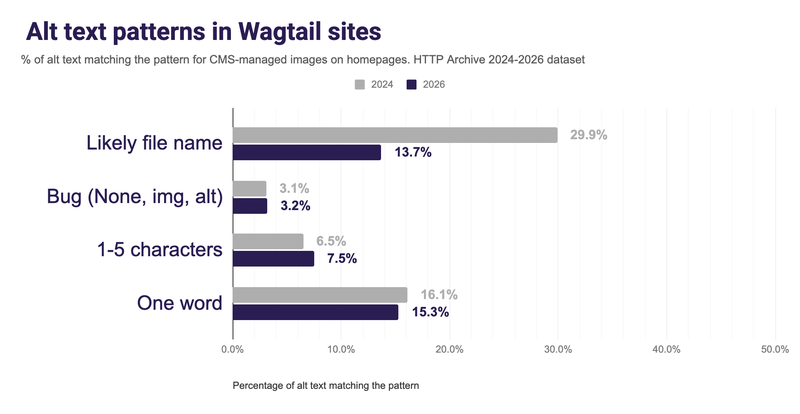
- Likely file name: An editor uses the file name as the alt text. Down to 13.7%, from 29.9% last year.
- Bug (None, img, alt): Likely developer mistakes. Now 3.2%, was 3.1%.
- 1-5 characters: For example "123". Now 7.5%, was 6.5%
- One word: This can be appropriate in specific contexts, but is often not descriptive enough. Was at 16.1%, now 15.3%.
There is a high likelihood we will introduce checks for more of those patterns in the future, as well as more advanced prompts in the Wagtail AI package. The results we’re seeing detecting and preventing file names are outstanding, but we want to be mindful to avoid checks that might do unwarranted flagging of appropriate text.
Data and methodology
The data we use comes from a dataset of the world’s top 15M website homepages: HTTP Archive. 7,000+ websites in this dataset are identified as using Wagtail.
From this dataset, we then extract specific statistics following the methodology of the HTTP Archive Web Almanac’s accessibility chapter – but filtering to only assess Wagtail projects. The filtered data is available in Google Sheets: Wagtail sites accessibility GAAD 2026 - Data.
What’s next
All indicators are positive this year but there’s still a lot to do across the wider Wagtail ecosystem, and that progress will depend on what we build and ship now. Come join us today and tomorrow at our free What’s New in Wagtail webinar where we talk through our recent releases and upcoming work, including updates to the content checker. And in early June, we’ll be at Wagtail Space NL where we’ll talk about our broader strategy, and we sprint on accessibility together 💪