What our AI guiding principles actually mean
Drafting the principles was easy, the hard part is what happens next.

As part of our new product strategy, we took a moment to refresh our AI guiding principles. Principles and policies are nice and all but they’re only useful when put to use and stress-tested. We’re due an overview of why each of our principles exists, and how they direct AI adoption in practice.
The principles
They’re all written and presented on equal footing but some of them do hit harder than others. Here they are, heading + description, followed by an explainer.
No AI dependency in Wagtail core
APIs and UI components in core will support the delivery of AI-powered capabilities in packages and custom development, but AI will not be a requirement for Wagtail core itself.
We want our users to be in control of when and how they adopt AI, so it’s essential that any AI features are as "opt-in" as it gets. In a platform with a thriving package ecosystem, this naturally means those features can live in separate packages, like Wagtail AI.
In core, we do make sure the correct extension points are there. For example, making sure packages could easily access the live preview’s rendered content in our latest 7.4 release.
Responsible approach to AI
High alignment with our values – ethical, environmentally sustainable, transparent, privacy-preserving.
This clearly matters to us and our community, as showcased in our 2026 DX with AI survey question, Please rate the importance of the following considerations for your team around AI adoption:
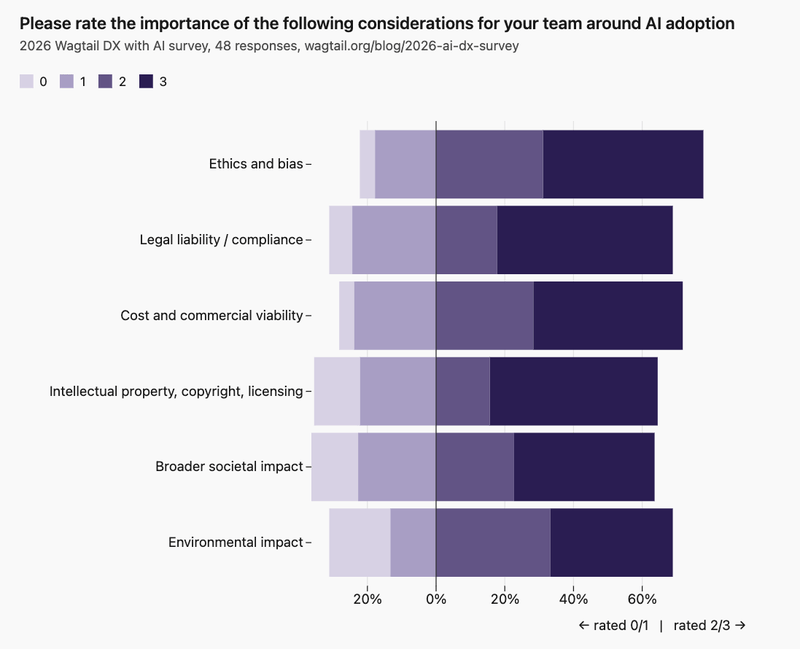
This principle is essential but also very challenging to put to use in practice. You can see it coming through in how we navigate open source maintenance challenges caused by AI adoption, as well as measuring (and reducing) the carbon footprint of Wagtail AI. That energy and resource use is getting very comparable to what it takes to actually publish a live site:
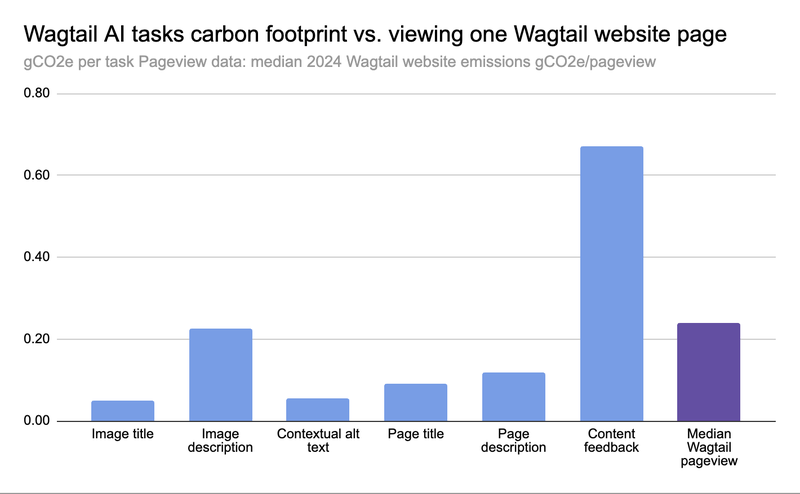
It’s crucial we understand how that scales - and work towards reducing both!
Model and provider agnostic
Compatible with a wide range of open source and small language models, not just large flagship proprietary models. Facilitating the use of the lower impact options whenever possible.
Being provider-agnostic is a pragmatic way to meet a lot of different needs, but it’s also essential when it comes to our "Responsible approach to AI" principle. We need to be able to select models or model families that have a better track-record of aligning with our values. That starts with comparing open weight AI models and providers to focus on smaller models. Drawing and navigating the pareto frontier:
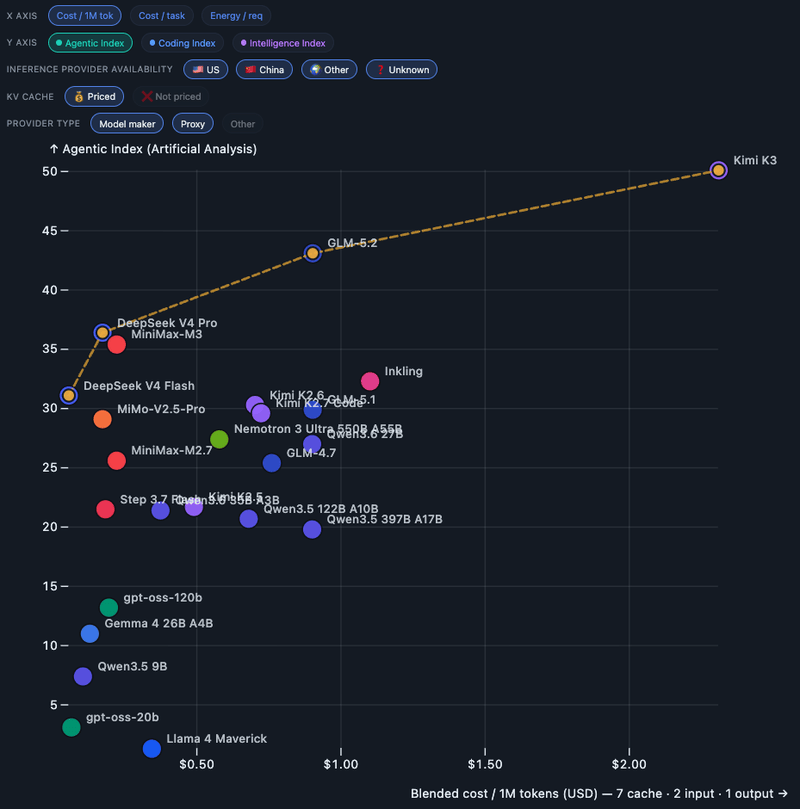
In practice, this means we focus on open weight options because they are much more widely available around the world, and much more transparent when it comes to their environmental impact and ethics track record.
Only the right AI
Rather than a presumption in favour of AI, focus only on the use cases where the application of AI delivers real, tangible value.
As in, we won’t be shipping layout builder soup markup, nor slop image generation. Enough said!
Human in the loop
Preserve the user’s autonomy and agency, and guard against the risks associated with hallucinations and probabilistic output.
This last principle is crucial, but its heading is becoming diluted. What we want to encourage is control over the loop, not mere presence. Avoid the reverse centaurs altogether. This is essential for our project both for content publishers and developers, making sure they retain a role that goes beyond accountability sinks. We’ll see this come through as we start more heavily adopting agent skills, seeing the ways in which the skills encourage steering from humans. Our initial experimentation with automating site upgrades worked really well in that regard.
Where that takes us
We’re happy with the principles as they now stand, but really should be under no illusion that any of this is settled. The paradigm shift is still well under way. We don’t know what will be on the other side. There will still be people who value our responsible approach to AI, and the impact of their technology on people and planet. Let’s build for them.
If you’re one of those people, join us in November for Wagtail Space 2026 - free, online, time zone inclusive. Call for proposals is now open!